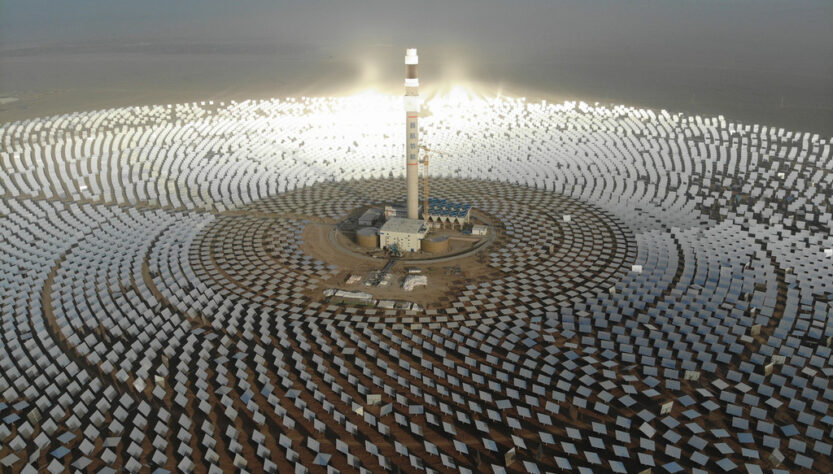
Imagine standing in the middle of China’s vast Gobi Desert—a harsh, sun-baked expanse where nothing much grows and the sky feels endless. Suddenly, you spot something that looks straight out of a sci-fi movie: a towering structure soaring 263 meters (about 863 feet, roughly the height of an 80-story skyscraper) into the blue. Surrounding it in a near-perfect circle are around 12,000 giant mirrors, each one carefully positioned across nearly 8 square kilometers (roughly 3 square miles) of barren land.
These aren’t ordinary mirrors. They’re called heliostats—flat, highly reflective surfaces mounted on trackers that follow the sun’s path across the sky like loyal robots. All day long, they tilt and turn in perfect coordination, bouncing sunlight onto a single small target at the very top of the tower. The result? Intense concentrated solar energy that cranks the temperature there above 800°F (around 427°C or higher at the receiver, with the system pushing molten salt even hotter overall).
How the Heat Gets Captured and Stored
That focused beam of light hits a receiver on the tower and superheats a special fluid flowing through it. The plant pumps this heat into massive tanks filled with molten salt—a mixture of sodium nitrate and potassium nitrate. At high temperatures, this salt turns into a glowing, liquid “hot soup” that can reach around 565°C (about 1,050°F).
Here’s the cool part: Unlike regular solar panels that make electricity only while the sun shines, this setup uses the molten salt as a giant thermal battery. The hot salt gets stored in insulated tanks, holding onto that captured solar energy for hours (some designs store enough for up to 11 hours or more of operation). When the sun goes down or on cloudy days, the plant draws from those tanks. The hot salt boils water into high-pressure steam, which spins turbines connected to generators—just like in a conventional power plant—to produce clean electricity around the clock.
This is concentrated solar power (CSP) with thermal storage, specifically a tower-type or “power tower” system. It’s different from photovoltaic (PV) solar panels you see on rooftops, which turn sunlight directly into electricity. CSP is more like using a giant magnifying glass to cook something with heat, then banking that heat for later.
Why Molten Salt? (And That Ancient Food Preservation Link)
The nitrates in these salts have been around for centuries in curing meats and other preservation methods because they inhibit bacteria. Today, the same salts shine in modern energy tech because they:
- Stay liquid at very high temperatures without breaking down easily.
- Store and release huge amounts of heat efficiently.
- Allow the system to run at high efficiencies for making steam.
When the salt cools after giving up its heat, it gets pumped back to the tower to be reheated—creating a closed loop that’s remarkably elegant.
The energy war just changed.
— StockMarket.News (@_Investinq) March 24, 2026
America burns coal at night to keep the lights on while China built something different and most people have no idea it exists.
In the middle of the Gobi Desert, there is a 263-meter tower surrounded by 12,000 mirrors in a perfect circle, spread… https://t.co/1NV2EWr43B pic.twitter.com/7yuvNnt4rm
Real-World Impact
This is how China’s Dunhuang 100 MW molten salt solar thermal power station in the Gobi Desert (near Dunhuang in Gansu Province) generates about 100 megawatts of power and produces hundreds of thousands of megawatt-hours of electricity per year. That’s enough to power tens of thousands of homes while slashing carbon emissions (avoiding around 350,000 tons of CO₂ annually, like planting hundreds of hectares of forest).
China has built several such plants in the Gobi and nearby deserts, including larger or dual-tower variants with even more mirrors and taller or multiple towers for better efficiency. The region is ideal: endless sunshine, cheap land, and plenty of space for mirror fields.
Why This Matters (Beyond the Sci-Fi Vibes)
Traditional solar panels are cheap and great for daytime power, but they struggle with “intermittency”—no sun means no power without expensive batteries. Molten salt storage turns sunlight into dispatchable energy you can use whenever needed, making renewables more reliable for the grid. It’s like having a solar plant that acts a bit like a peaker plant or even baseload power.
Of course, these systems are complex and expensive to build upfront (tracking mirrors, tall towers, corrosion-resistant salt handling). But in sunny deserts, they shine—literally. Engineers keep improving them with better mirrors, dual-tower designs, and longer storage.
In short, this Gobi “sun furnace” is a clever way to bottle sunshine as heat and turn the desert’s greatest asset (unrelenting sun) into steady, clean electricity—even after dark. It’s a reminder that sometimes the most futuristic tech is just really smart engineering applied to ancient ideas, like using salts to hold energy instead of food.
The implications are enormous. The oldest argument against solar energy has always been: “What happens at night?” China just answered that question with 12,000 mirrors and a tower visible from space.